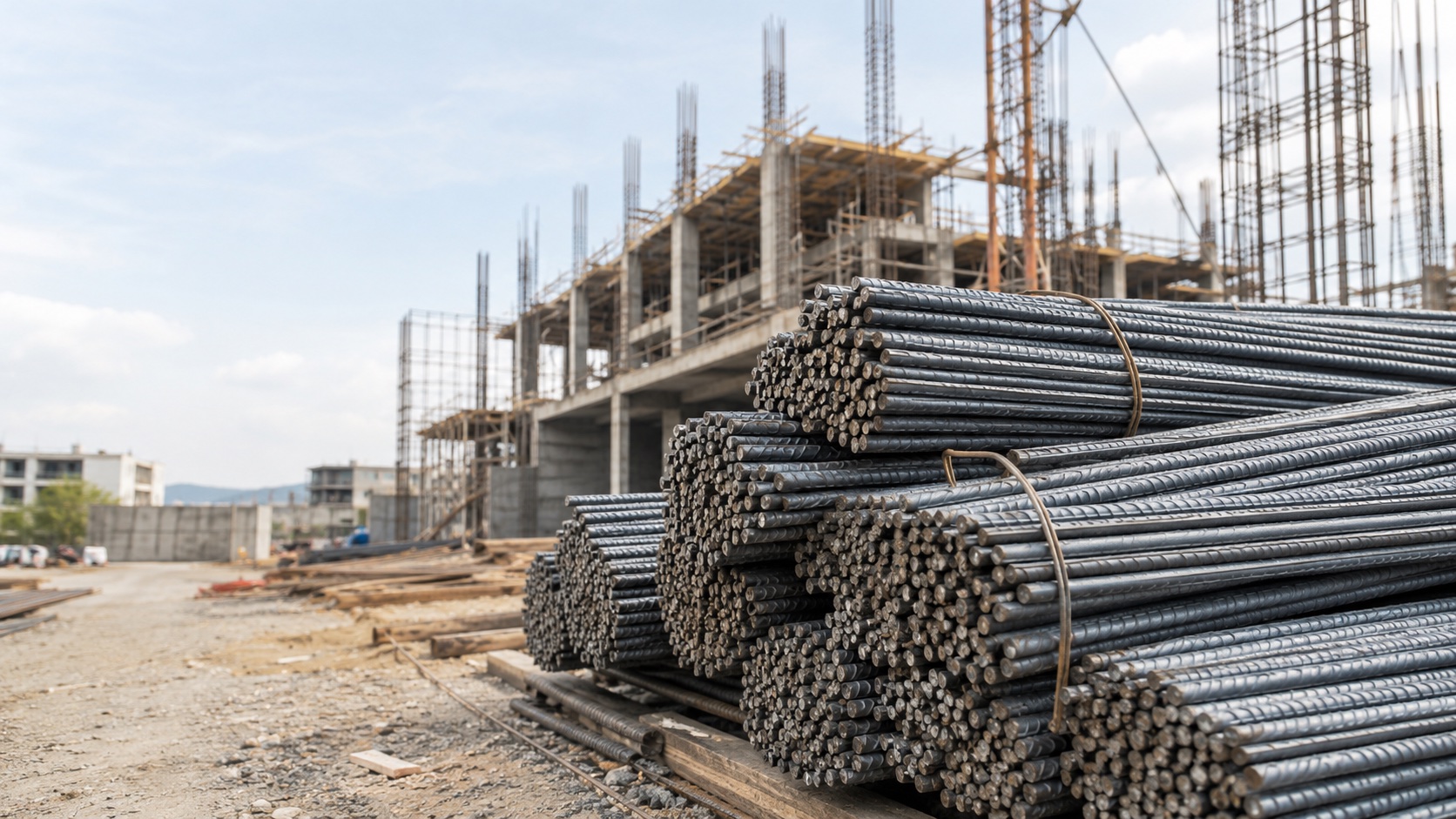
What Is TMT Steel? Complete Guide to Reinforcement Bars in Nigeria
A building’s strength depends on more than the quality of its concrete, the thickness of its walls or the appearance of its finishes. The reinforcement steel inside its concrete elements also plays a critical role in how the structure carries loads and responds to stress.
This is why TMT steel rods are an important consideration when planning residential buildings, commercial developments, bridges and other reinforced concrete structures.
However, not every buyer understands what TMT steel means, how it is manufactured, which properties matter when selecting reinforcement bars, or how to verify that the material delivered to a construction site meets the project specification.
This guide explains TMT reinforcement steel in practical terms, with particular attention to construction procurement in Nigeria. Whether you are a structural engineer, contractor, quantity surveyor, property developer or homeowner building in Abuja, understanding these fundamentals can help you make better purchasing decisions.
What Is TMT Steel?
TMT stands for Thermo-Mechanically Treated. TMT steel is reinforcement steel manufactured through controlled hot rolling and thermal treatment to achieve specified mechanical properties, including strength and ductility.
TMT reinforcement bars, commonly called TMT rods or steel rods, are used inside reinforced cement concrete (RCC). Concrete performs well under compression but has relatively low tensile strength. Steel reinforcement helps resist tensile forces and contributes to the structural element’s ability to withstand bending and other actions.
The ribs on deformed reinforcement bars improve mechanical interlock with the surrounding concrete, helping the two materials act together when properly designed and constructed.
TMT is a description of a manufacturing process, not a diameter or a strength grade. A TMT bar must still meet the applicable material specification and the requirements stated in the structural design.
For Nigerian projects, buyers should confirm the required grade and applicable Nigerian Industrial Standard with their engineer or procurement team. The Standards Organisation of Nigeria lists NIS 117:2024 as a specification for steel bars for the reinforcement of concrete, Grade 420. The applicable standard must be checked against the project’s specified reinforcement product and grade.
How Is TMT Steel Manufactured?
The manufacturing process is important because it influences the finished bar’s mechanical properties.
Although specific production systems vary between mills, the typical TMT process involves the following stages.
1. Steel billet preparation
Steel billets are prepared as the raw material for rolling. Their chemical composition and quality influence the finished reinforcement bar’s properties.
Poor control of raw materials cannot be corrected simply by giving the finished bar a ribbed surface or an attractive appearance.
2. Heating and hot rolling
The billet is heated and passed through rolling stands, which progressively reduce its cross-section and shape it into reinforcement bars.
During the final stages, the bar is formed to the specified diameter and surface-rib profile.
3. Rapid quenching
Immediately after hot rolling, the bar passes through a controlled cooling system, commonly using water. Rapid cooling changes the microstructure of the outer region of the bar.
4. Self-tempering
Heat remaining in the bar’s hotter core flows towards the cooled exterior. This process tempers the outer region, helping establish a balance of strength and toughness.
5. Final cooling and inspection
The bar cools further, and its mechanical properties develop through the resulting microstructure. Finished products should undergo the manufacturer’s required inspection and quality-control procedures.
A typical quenched-and-self-tempered reinforcement bar has a relatively hard outer region and a more ductile ferrite-pearlite core. Research on TMT and quenched-and-self-tempered reinforcement bars describes this combination as an important feature of the process.
Practical implication: The appearance of a steel rod alone cannot establish whether it has the correct strength, ductility, chemical composition or manufacturing quality. Compliance must be verified through appropriate documentation and, where necessary, testing.
Key Properties of TMT Reinforcement Steel
The suitability of reinforcement steel depends on its specified properties and how those properties relate to the structural design.
1. Yield strength
Yield strength is the stress at which steel begins to undergo significant permanent deformation according to the applicable test definition.
It is important in structural design because reinforcement must resist the forces expected in the member without exceeding the design limits.
A higher strength grade is not automatically the correct choice for every building. The engineer must consider the specified grade alongside bar diameter, reinforcement arrangement, concrete strength, anchorage, detailing and other design requirements.
2. Tensile strength
Tensile strength describes the maximum tensile stress a material can withstand during a tensile test.
It is relevant to the behaviour of reinforcement under tension. However, tensile strength should not be considered in isolation: yield strength, elongation, the ratio between tensile and yield strength, and other specified properties can also matter.
3. Ductility
Ductility is the capacity of steel to deform plastically before fracture.
This property matters because structural elements may experience changing loads and localised deformation during service or extreme events. Reinforcement with the required ductility can contribute to the intended structural response.
Ductility is measured through prescribed mechanical tests. It cannot be reliably judged by bending a rod by hand or striking it with a hammer.
4. Bond with concrete
Deformed bars have ribs that help transfer forces between the reinforcement and the surrounding concrete.
Good structural performance still depends on correct bar placement, concrete cover, embedment, anchorage, lap lengths, concrete quality and proper compaction. A ribbed bar cannot compensate for poor reinforcement detailing or defective concrete work.
5. Bendability and fabrication
Reinforcement bars are bent into shapes required for beams, columns, slabs, foundations and other concrete elements.
The bar must satisfy the specified bending requirements, and fabrication should follow the engineer’s bar-bending schedule and applicable standards.
Uncontrolled heating, repeated bending and straightening, or bending below the permitted radius can compromise reinforcement. Site teams should follow the specified fabrication procedure rather than improvising.
6. Corrosion resistance in service
Steel can corrode when the conditions around it permit the necessary electrochemical reactions. Corrosion risk depends on factors such as moisture, oxygen, chlorides, concrete quality and the adequacy of the protective concrete cover.
TMT processing does not make ordinary reinforcement steel immune to corrosion.
Durability requires appropriate concrete cover, suitable concrete quality, adequate drainage, good workmanship and, where exposure conditions demand it, additional protective measures specified by the design team.
What Are the Common Sizes of TMT Steel Rods?
TMT reinforcement bars are supplied in different nominal diameters. Each diameter represents a different cross-sectional area and nominal mass per metre.
Common sizes encountered in building-material procurement include 6 mm, 8 mm, 10 mm, 12 mm, 16 mm, 20 mm, 25 mm and 32 mm. Availability varies by supplier, manufacturer and product specification.
How long is a standard TMT rod?
In many Nigerian building-material transactions, reinforcement rods are sold in nominal 12-metre lengths. However, buyers should confirm the actual supplied length, product specification and commercial terms before calculating quantities or comparing quotations.
For example, a nominal 12-metre rod with a 12 mm diameter has an approximate theoretical mass of 10.67 kg. A different diameter will have a different mass, even if the length is identical.
This is one reason procurement teams should specify diameter, grade, length, quantity and the agreed supply basis instead of ordering simply by the term “steel rods.”
TMT Steel Grades: What Do the Numbers Mean?
A reinforcement grade identifies specified mechanical requirements under the relevant standard. The exact designation and its meaning depend on that standard.
For example, a grade designated 420 under a relevant specification may have a specified minimum yield or proof strength of 420 N/mm². The full product standard determines the applicable test method, mechanical-property limits, chemical requirements and acceptance criteria.
Do not assume that grade designations used in one country are automatically interchangeable with those used in another.
When purchasing reinforcement steel in Nigeria, confirm the following:
-
- The exact grade stated on the approved structural drawings.
-
- The applicable Nigerian or otherwise approved product standard.
-
- The manufacturer’s identification and product documentation.
-
- The specified mechanical properties and relevant test certificates.
-
- Any project-specific requirements for ductility, welding or exposure conditions.
A supplier should not substitute one grade for another solely because the alternative has a higher advertised strength or is available at a lower price. Changes to the reinforcement specification require the appropriate approval from the responsible design professional.
Where Is TMT Steel Used in Construction?
TMT reinforcement bars are used in reinforced concrete components across residential, commercial and civil engineering projects.
1. Building foundations
Reinforcement may be used in pad foundations, strip footings, raft foundations and other foundation systems where required by the design.
Foundation reinforcement must reflect the ground conditions, structural loads, foundation type and detailing requirements. A buyer should not estimate foundation steel from building size alone.
2. Columns and beams
Columns transfer loads through the structure, while beams resist bending and shear and transfer loads to their supports.
Reinforcement diameter, spacing, anchorage, confinement and detailing must follow the structural design. Incorrect substitutions or poorly fabricated reinforcement can affect structural performance.
3. Suspended slabs
Reinforcement in suspended slabs helps resist tensile stresses and control cracking in accordance with the design.
The required reinforcement depends on factors including span, support conditions, loading, slab thickness and the structural system.
4. Staircases
Reinforcement is incorporated into concrete stair flights and landings where required. Correct bar placement and anchorage are important to ensure the reinforcement functions as intended.
5. Retaining walls and other civil works
Reinforced concrete retaining walls, drainage structures, culverts and other civil engineering components may also require steel reinforcement, depending on the design.
Across all these applications, the same principle applies: reinforcement must be selected and installed according to the engineered specification, not merely according to what is readily available on site.
TMT Steel vs Ordinary Mild Steel: What Is the Difference?
The terms “TMT steel” and “ordinary steel rod” are sometimes used loosely in commercial conversations. A meaningful comparison requires identifying the actual product, manufacturing route and mechanical specification.
TMT reinforcement bar:
Manufacturing : Hot rolling followed by controlled thermomechanical treatment Mechanical properties: Designed to meet the specified strength and ductility requirements Surface: Commonly supplied as a deformed bar with ribs Design suitability: Must meet the grade and properties specified for the structure Quality verification: Requires identification, documentation and appropriate tests
Conventional mild-steel reinforcement
**Manufacturing: **Depends on the particular product and manufacturing route Mechanical properties: Depends on the steel grade and product specification Surface: May be plain or deformed, depending on the product Design suitability: Suitable only where its actual properties meet the design requirements Quality verification: Requires the same disciplined verification
The important point is not that one label guarantees better performance. The actual material specification, test results, traceability and suitability for the intended structure determine whether a particular product is acceptable.
A low-cost bar that does not meet the project’s requirements is not a sound procurement saving.
How to Identify and Buy Quality TMT Steel in Nigeria
For contractors, developers and homeowners, steel procurement should be treated as a quality-control activity rather than a price-only transaction.
1. Confirm the project specification
Obtain the approved structural drawings and bar-bending schedule. Confirm the required diameters, grades, quantities, lengths and any special requirements.
If the specification is unclear, ask the structural engineer before placing the order.
2. Verify the supplier and product identity
Request clear information about the manufacturer, product grade, applicable standard and available quality documentation.
Check that the markings and documentation correspond to the actual product supplied. A brand name or printed label alone is not proof of compliance.
3. Request relevant test documentation
Depending on the project and applicable standard, relevant documents may include a mill test certificate or material test report identifying the product’s chemical composition and mechanical properties.
For critical projects or where a concern arises, arrange independent testing through a competent laboratory using appropriate sampling and test methods.
4. Inspect the delivery
At delivery, check the following:
-
- Diameter and product identification correspond to the purchase order.
-
- The supplied quantity and agreed length match the order.
-
- Bundles and documents are identifiable and traceable.
-
- Bars show no serious damage, deep pitting or other defects that warrant rejection or technical assessment.
-
- Any visible contamination or unusual condition is reported before the material is accepted for use.
Light surface rust does not automatically mean a bar is unusable. Its significance depends on the severity of corrosion, loss of section, surface condition and applicable acceptance criteria. Deep pitting, flaking corrosion or suspected section loss should be assessed before use.
5. Store the reinforcement correctly
Keep bars organised by diameter, grade and delivery batch. Where practicable, store them above the ground on suitable supports, away from standing water and avoidable contamination.
Good storage makes identification easier and helps the site team manage materials before installation.
6. Do not rely on informal strength tests
Hitting a bar with a hammer, trying to break it by hand or bending it without a controlled procedure cannot establish compliance with a reinforcement standard.
Where mechanical properties are in doubt, use the required testing procedure and competent technical assessment.
How Much TMT Steel Does Your Building Need?
The required quantity depends on the structural design and the reinforcement details for each component.
A reliable estimate generally uses the approved bar-bending schedule or derives quantities from the structural drawings. It accounts for the number of bars, cut lengths, bends, hooks, laps, anchorage and any specified wastage allowance.
For a simple illustration, suppose a schedule specifies 40 straight bars, each 12 metres long. The total scheduled length is:
40 × 12 m = 480 m.
If those bars are 12 mm in diameter, their approximate theoretical mass is:
480 m × 0.889 kg/m = 426.72 kg.
This is an illustration of quantity conversion, not a steel estimate for a real building. The actual purchase quantity depends on the full reinforcement schedule, fabrication details, permitted tolerances, supply lengths and procurement arrangements.
Why estimating from floor area alone can be misleading
Two buildings with the same floor area may require different quantities of reinforcement because of differences in:
- Number of storeys and structural layout.
- Foundation type and ground conditions.
- Column spacing and beam spans.
- Slab system and loading requirements.
- Structural design, detailing and applicable code provisions.
For a homeowner building in Abuja, a practical approach is to obtain the structural drawings and bar-bending schedule before requesting quotations. This gives the supplier a defined basis for estimating and makes quotations easier to compare.
A professional estimate should distinguish the quantities specified by the design from any additional allowance used for procurement and cutting.
Common TMT Steel Buying Mistakes to Avoid
1. Buying by diameter alone: Two bars of the same nominal diameter may differ in grade, manufacturing quality or compliance. Confirm the complete specification.
2. Choosing the lowest quotation without checking the supply basis: Compare grade, diameter, quantity, length, documentation, delivery arrangements and applicable taxes or charges.
3. Accepting undocumented substitutions: Do not allow a different grade or diameter to be used without the required technical approval.
4. Assuming visible ribs prove quality: Surface appearance cannot establish yield strength, tensile strength, ductility or chemical composition.
5. Ordering too early without a storage plan: Large deliveries need appropriate storage, identification and inventory control.
6. Waiting until reinforcement is needed before arranging supply: Late procurement can disrupt the site programme. Plan orders around the construction sequence and confirm stock and delivery arrangements in advance.
Frequently Asked Questions About TMT Steel
1. What does TMT stand for in construction?
TMT stands for Thermo-Mechanically Treated. It describes a manufacturing process used to produce reinforcement steel with specified mechanical properties.
2. Is TMT steel suitable for building a house in Nigeria?
TMT reinforcement steel can be used in reinforced concrete houses when the supplied product meets the applicable specification and the structural engineer’s requirements. The correct grade, diameter, quantity and detailing depend on the approved design.
3. Which TMT rod size is best for a building?
There is no single best diameter for every building. The required sizes depend on the structural element, loads, spans, concrete design and reinforcement details. Follow the approved structural drawings and bar-bending schedule.
4. How can I tell whether TMT steel is genuine?
Check the manufacturer’s identification, product markings, relevant test documentation and conformity with the applicable standard. Where necessary, arrange independent material testing. Visual inspection alone cannot prove that a bar meets its specified mechanical properties.
5. Does TMT steel rust?
Yes. TMT steel can corrode when exposed to conditions that support corrosion. Proper concrete cover, sound concrete, appropriate construction practices and suitable exposure protection help reduce the risk.
6. What is the difference between TMT steel and high-tensile steel?
TMT describes a manufacturing process, while high-tensile describes a strength characteristic. A TMT bar may be manufactured to a high-strength reinforcement specification, but the actual grade and properties must be verified rather than inferred from the terminology.
7. How many TMT rods are needed for a three-bedroom bungalow?
The quantity cannot be determined reliably from the bedroom count alone. It depends on the structural drawings, foundation design, number of storeys, spans, reinforcement sizes and detailing. Request an estimate based on the approved drawings and bar-bending schedule.
8. How is the weight of a TMT steel rod calculated?
An approximate theoretical mass per metre can be calculated using diameter² ÷ 162, with diameter in millimetres and mass in kilograms per metre. Multiply the result by the total length to estimate theoretical mass. For procurement acceptance, use the applicable product standard and agreed supply basis.
9. What documents should I request when buying reinforcement steel?
Request the product grade and applicable standard, manufacturer identification, relevant material test certificates or reports, and delivery documentation. Additional requirements depend on the project specification and procurement contract.
10. Where can I buy TMT steel rods in Abuja?
There are many suppliers of TMT steel rods and other building materials for construction projects in Abuja. Buyers can contact their team to discuss their required sizes, quantities, product specifications and delivery arrangements.
Conclusion: Choose TMT Steel With the Right Specification and Supply Support
TMT steel is an important reinforcement material in modern reinforced concrete construction. Its manufacturing process is intended to achieve a useful combination of strength and ductility, but the actual performance of any supplied bar depends on compliance with the applicable specification and correct use in the structure.
For buyers in Nigeria, the purchasing process should begin with the structural specification, not the price list. Confirm the grade, diameter, quantity, documentation and delivery requirements before committing to an order.
Reliable procurement also means planning quantities accurately, checking deliveries and coordinating supply with the construction programme.
Need TMT Steel Rods for Your Project in Abuja?
EDU TMT Steel Limited helps contractors, developers, engineers and homeowners source building materials with practical procurement support.
Whether you are starting a residential building, managing a commercial development or arranging a bulk reinforcement order, our team can help you discuss your material requirements and obtain a quotation.
EDU TMT Steel Limited
Built to Build Abuja.